Convent of the Holy Ghost
The LeopardThe Convent of the Holy Ghost is an enclosed convent just outside the town, founded by Blessed Corbèra, an ancestor of Don Fabrizio Corbera, Prince of Salina. Its strict separation from the male world is qualified by a hereditary exception: the Prince may enter because he descends from its foundress. The convent thus brings family history, religious observance, and aristocratic privilege into the same protected space, where a formal visit also exposes a strained moment between Tancredi Falconeri and Concetta Salina.
Foundation and Enclosure
A longstanding family custom requires the Salinas, on the day after arriving in town, to visit the convent and pray at the tomb of Blessed Corbèra. The foundress endowed the institution, lived there a holy life, and died there. The visit therefore renews a bond that is at once devotional and genealogical: the family approaches a sacred tomb, but the person who enjoys exceptional access does so as the foundress’s direct descendant.
The convent’s rule of enclosure rigidly bars men from entering. The Prince is the sole exception among the Salinas, a privilege he shares only with the King of Naples. He is notably proud of this right, and his pleasure in the convent begins with the fact that its boundary does not exclude him. The rule makes his access strikingly personal: the same threshold that keeps other men outside admits him because of inherited status, not because the enclosure has ceased to matter.
The convent’s parlour gives this boundary a material form. It has a barrel-vaulted ceiling centred on the Leopard, double gratings for interviews, a small wooden wheel for passing things in and out, and a heavy door whose threshold only the Prince and the King are permitted to cross. The wheel and grilles allow limited exchange without dissolving separation; the door marks the more consequential distinction between those who may enter and those who may not. The convent’s devotional world is therefore presented through both its legends and the practical architecture that controls access to it.
Devotional Life and the Prince’s Visits
The Prince takes pleasure in details throughout the convent. He admires the nuns’ wide, finely pleated white linen wimples against their rough black robes, and listens to the Mother Abbess recount the Blessed One’s miracles. One story concerns a huge stone that the Devil, angered by the saint’s austerity, hurled at her; she is said to have suspended it in the convent garden. Another devotional curiosity is a pair of framed, indecipherable letters: one from Blessed Corbèra urging the Devil to virtue, the other apparently expressing his regret that he cannot comply.
His satisfaction is not limited to the convent’s stories or appearance. He enjoys the almond cakes made according to an ancient recipe and the Office chanted by the nuns. He also pays the community a substantial part of his own income, as required by the act of foundation. His repeated visits thus combine inherited obligation with personal enjoyment: prayer at the tomb, attention to the nuns’ traditions, food, music, and a continuing financial contribution all belong to the same practice of family devotion.
The Salina Visit and the Closed Door
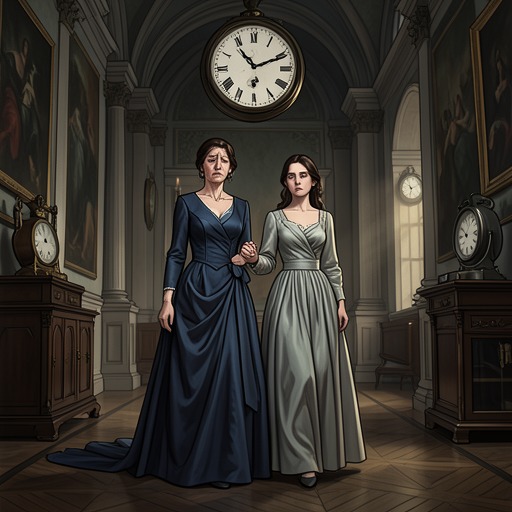
On the morning after the family’s arrival, two carriages travel to the convent. The first carries the Prince, the Princess, and their daughters Carolina and Concetta; the second carries Caterina, Tancredi, and Father Pirrone. Because the latter two are men without the Prince’s exceptional right, they must remain in the parlour while the women and the Prince make the visit. Concetta seems composed but somewhat absent-minded, while the Prince hopes that the previous day’s worries have passed.
The admission is delayed even though the visit has been announced. Near the end of the wait, Tancredi asks his uncle to obtain permission for him to enter. He points to a provision allowing the Prince, if the Abbess consents, to bring two gentlemen of his suite, and offers to serve as his squire. The Prince is pleased by the request and begins to consider asking. Tancredi’s appeal makes the rules seem negotiable, but only through the Prince’s authority and the Abbess’s permission; it does not erase the distinction between his inherited access and the restrictions placed on the other men.
Concetta stops the exchange with a cutting suggestion that Tancredi fetch a piece of wood lying outside a house, then says more sharply that he has already been in one convent and should not enter this one. Tancredi’s face reddens and his eyes cloud, whether from shame or anger. The doors open before the Prince can ask what her words mean, and Tancredi is left walking outside beneath the blazing sky. The scene turns the convent’s rule into a personal boundary as well as a religious one: a place of family observance becomes the setting for a rebuff between cousins.
The Visit’s Outcome and Significance
Inside, the visit proceeds with the expected acts of reverence and family routine. The tomb is venerated, the nuns’ watery coffee is tolerated, and their pink and greenish almond cakes are eaten with satisfaction. The Princess inspects the vestment press; Concetta speaks with her usual withdrawn kindness; and the Prince leaves ten ounces of gold on the refectory table, the offering he makes each time he comes. His habitual payment makes the visit more than a single ceremonial gesture: it sustains the foundation to which the family’s tradition binds him.
Father Pirrone is found alone at the door. He reports that Tancredi suddenly remembered an urgent letter and went off on foot, and nobody asks further about his absence. The Prince has deliberately avoided asking Concetta what she meant, treating her words as one of the cousins’ usual quarrels. He welcomes the resulting coolness because it spares him trouble, discussions, and decisions. The convent visit therefore closes on two different registers: its religious customs are carried out successfully, while the family conflict exposed at the threshold remains unexplained. The enclosure preserves the convent’s devotional order, but the scene also shows how social rank and private tensions accompany the family even into a place organized around sacred separation.